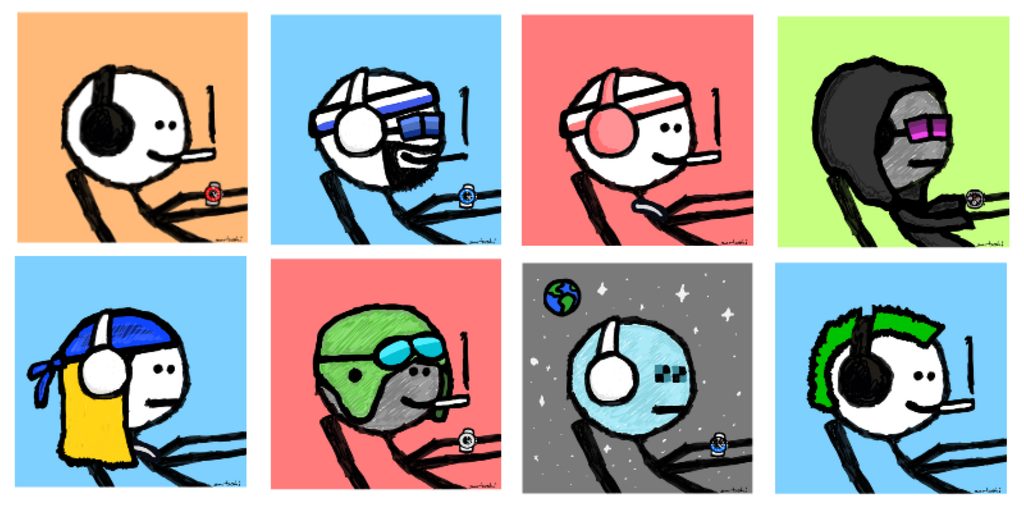
mfers is an Ethereum profile-picture NFT collection created by the pseudonymous artist Sartoshi. Its loose, hand-drawn characters and CC0 dedication made it a visible example of meme-driven NFT culture and open reuse; owning a token and using the artwork are separate questions.
What the collection contains
The familiar mfer is a seated stick figure with simple line art and variable traits such as clothing, headphones, backgrounds and accessories. OpenSea describes 10,000 algorithmically generated pieces and 21 hand-drawn one-of-ones; its live collection page displays 10,021 items. That distinction helps explain why descriptions may say “10k” while a marketplace listing shows a larger total. The collection is on Ethereum and dates to November 2021.
These are profile-picture collectibles: a token records a particular item in the collection. The image and the token are related, but a token purchase does not itself promise a game function, income, resale value or control over a project.
CC0 and reuse
The project has been described as CC0. Under the Creative Commons CC0 1.0 dedication, a rights holder waives copyright and related rights as far as the law allows, with a fallback public license. In practical terms, that permits copying, adapting and commercial reuse of covered artwork without asking that rights holder for permission.
CC0 does not waive trademark, patent, privacy or publicity rights, and it does not imply endorsement. It also does not turn an NFT into exclusive copyright ownership. The exact status of a particular use can depend on the material and applicable law; CC0 is not a blanket clearance for every name, likeness or third-party element.
Sartoshi’s departure and community role
In June 2022, Sartoshi announced a “new era” and the end of their public role. Rarible’s contemporaneous report described the transition as handing the project’s reins to the community and interviewed six participants. That supports describing mfers as community-led in its post-founder period, but it does not establish that every decision is made by a formal DAO or that the project has a single, permanent governance structure.
Open reuse also means that independent derivative projects can use the visual language. A derivative collection is not automatically the same contract, collection, or project as the original mfers. Check the contract and collection identity before treating a similarly named asset as an original.
Common misconceptions
- “CC0 means NFT holders own the copyright.” CC0 concerns copyright in covered works; a token is a blockchain record associated with an item, and the two should not be conflated.
- “The listed count must be exactly 10,000.” OpenSea’s explanatory text distinguishes 10,000 generated pieces from 21 hand-drawn one-of-ones, while its live listing shows 10,021 items.
- “Community-led means risk-free or permanently active.” It describes a project’s organization, not a guarantee of maintenance, liquidity, governance participation or future development.
Social Media Sentiment
- A post in r/NFTmarket asks whether anyone still holds mfers. It is one user’s question, not a representative survey; it shows that continued ownership was being discussed, but cannot establish current holder activity or an overall community view.
Last updated: 2026-10
Related Terms
See Also
- NFTs and Digital Game Ownership — explains how token ownership differs from control over digital game content.
- Why Calling It a Wallet May Have Been Crypto’s Biggest Mistake — looks at the language and assumptions around digital media ownership.
- OpenSea’s Trading Cards Tab: What Do You Actually Own? — compares digital collectibles with physical cards and the claims attached to each.
- Trade crypto with ChangeNOW
Sources
- OpenSea’s mfers collection overview — describes the 10,000 generative works, 21 hand-drawn one-of-ones, creator and live collection listing.
- Rarible’s 2022 mfers community interviews — reports Sartoshi’s June 2022 transition and includes perspectives from six community participants.
- Creative Commons CC0 1.0 deed — explains permitted copyright reuse and clarifies that trademark, privacy, publicity and endorsement rights are not waived.